
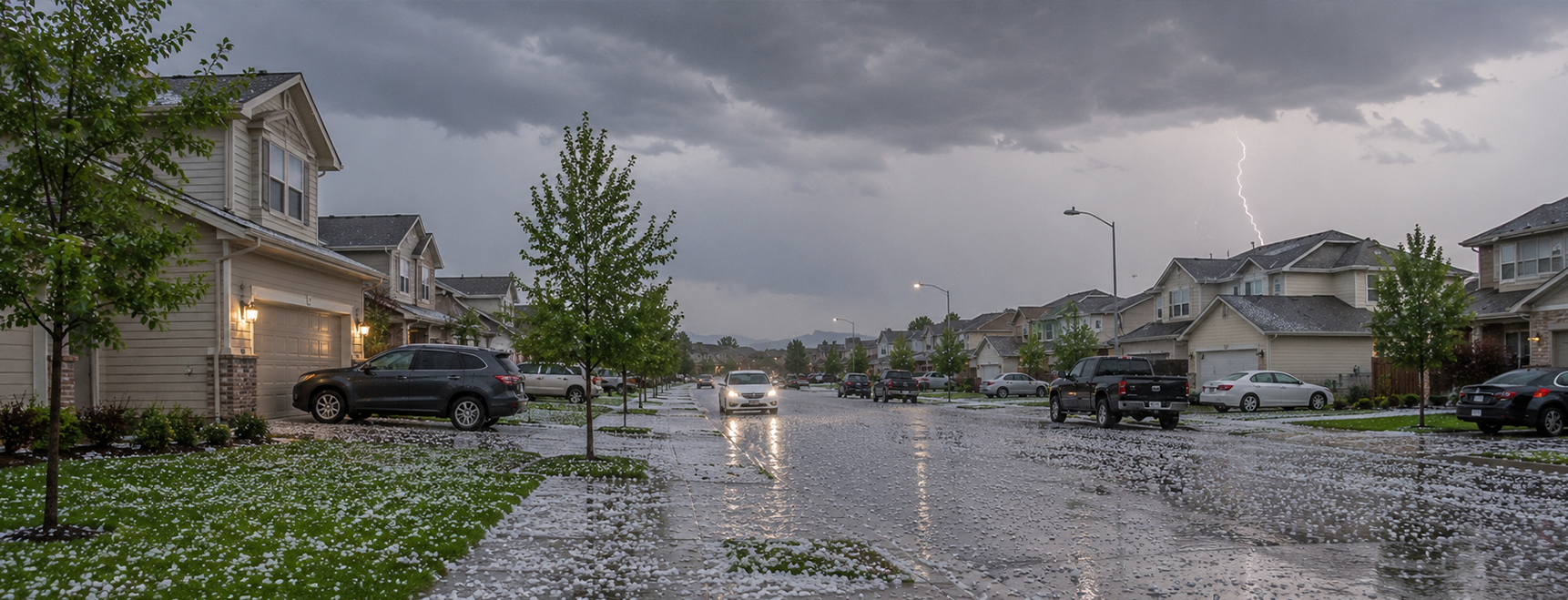
Every spring, the same pattern repeats. A storm system rolls through the Plains or the Midwest, the phones light up, and within seventy-two hours carriers are sitting on a backlog that didn’t exist on Monday. Hail season has a way of exposing everything – staffing models, file standards, ladder logistics, and the quiet assumptions baked into a claims operation the rest of the year.
Adjusters in the field carry the visible weight of it. But anyone who has worked hail volume long enough knows the truth: the inspection itself is rarely where things go wrong. What breaks down is everything around it.
This piece is for the adjusters walking roofs this spring, and for the claims leaders trying to keep cycle times honest while volume climbs. A few things worth keeping in front of mind.
Hail Damage Isn’t Always Obvious, and That’s the Problem
Wind damage announces itself. Hail rarely does. A roof can look completely intact from the driveway and still have functional damage across two slopes. Soft metals tell the story before the shingles do – gutters, downspouts, vents, AC fins, mailbox tops. An experienced independent property claims adjuster reads those first because they confirm whether hail of damaging size actually fell at that address, before a single shingle gets evaluated.
The trouble is that hail damage insurance claims are increasingly contested. Public adjusters and contractors are sharper than they were a decade ago. Photos that would have closed a file in 2015 won’t hold up today. Test squares need to be marked, measured, and photographed with context. Slope orientation matters. Date-stamped imagery matters. The defensibility of a roof hail damage claim now lives or dies in the documentation, not the verbal narrative.
This is where files start to drift during a surge. Adjusters know what to do. They just run out of daylight.
The Ladder Assist Question
Steep roofs, two-story homes, tile, slate, and anything with a pitch above 8/12 – these slow a route down faster than weather does. Ladder assist companies exist for exactly this reason, and during peak hail weeks they become the difference between a route of six inspections and a route of three.
The carriers who handle hail surges well tend to share one habit: they line up ladder assist capacity before the storm tracks come in, not after. Spring hail isn’t a surprise. The geography is predictable, the timing is predictable, and the homes that will need ladder support are predictable too. Treating ladder logistics as a pre-season decision rather than a reactive scramble removes one of the most common sources of cycle time loss during CAT weeks.
Where Large Loss Hits the File
Most hail claims are residential and routine. But every spring brings a quieter category that deserves more attention than it usually gets – commercial roofs, multi-family properties, agricultural structures, and the occasional total-replacement scenario that quietly crosses into large loss territory.
Large loss claims adjusters approach hail differently. Scope discipline matters more. Engineering reports come into play. Code upgrades, ordinance and law coverage, and matching disputes can move a file from a clean ACV calculation into something that needs significantly more documentation. The risk during a surge is that these files get triaged the same way as a single-family residential claim. They shouldn’t be. A commercial TPO roof with directional hail bruising deserves the time it deserves, even if the queue is full.
Recognizing the file early is most of the battle.
Communication Is Half the Claim
Policyholders during hail season are nervous, often misinformed, and frequently working from a contractor’s interpretation of their roof before the adjuster ever arrives. The independent claims adjusters who manage this well do something simple – they set expectations on the first call. What the inspection will cover. What hail damage actually looks like. Why the adjuster is photographing soft metals before climbing. What happens after the inspection and roughly when.
It sounds small. It prevents an enormous percentage of supplement disputes and reopens later. A claim that started with a clear conversation almost never becomes a complaint file.
What Carriers Are Really Watching
Behind the scenes, claims leadership during hail season is watching a small set of numbers – average cycle time, reopen rate, supplement frequency, customer survey scores, and file accuracy on QA review. Those metrics tell the real story of a vendor’s performance, not headcount or coverage maps.
This is where the operational side of a hail program matters more than the field side. Routing efficiency, QA before submission, photo standards consistent across every adjuster on the deployment, supplement protocols defined in advance – these are the things that hold cycle time steady when volume triples. A hundred good adjusters working without a shared standard will still produce inconsistent files. A smaller team working inside a defined process won’t.
A Final Note for the Field
Spring hail will keep doing what spring hail does. The storms will arrive on their own schedule, the volume will spike, and the adjusters who walk those roofs will carry the season on their shoulders the way they always have.
The work is to make sure the system behind them is built to hold up too. Clean documentation, prepared ladder assist, early identification of large loss exposure, honest communication with policyholders, and QA standards that don’t slip when the queue gets long. That’s what Claims Plus™ is built around at Aspen, and it’s what separates a hail season that runs to plan from one that runs the team into the ground.
If you’re evaluating your carrier’s hail deployment model ahead of this season, Aspen’s team is worth a conversation.