
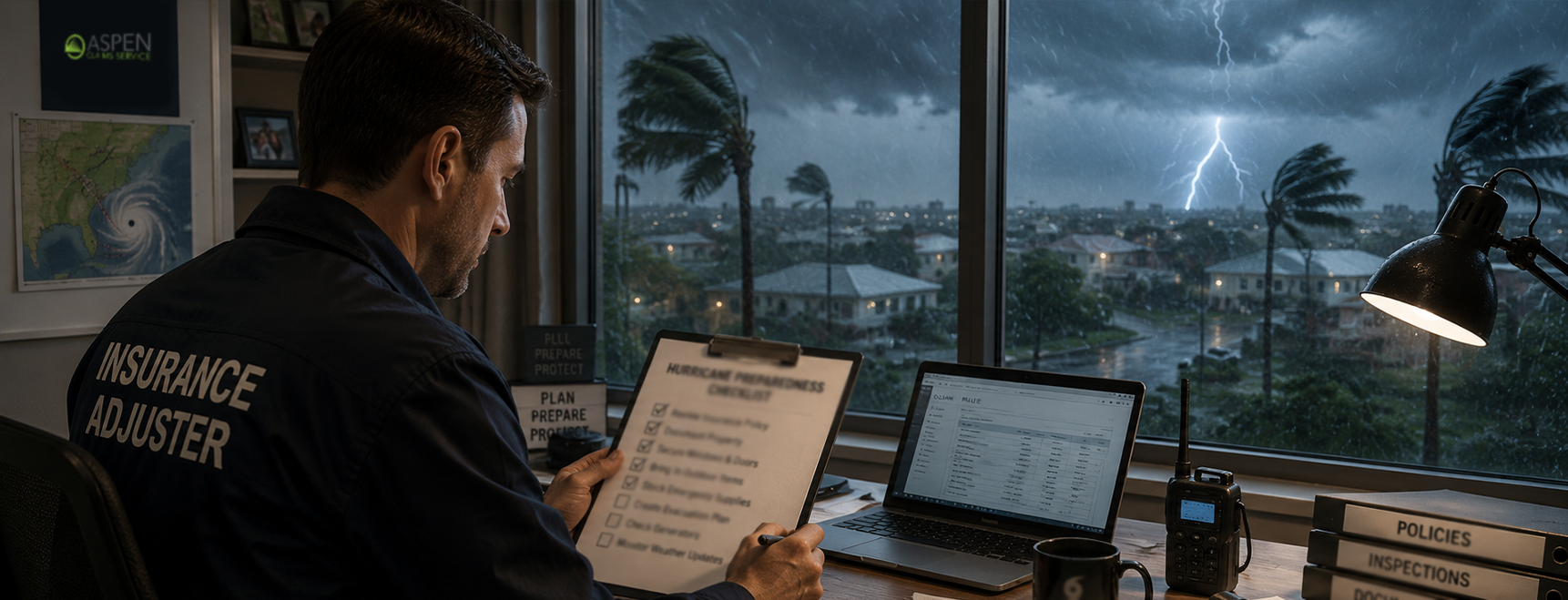
Every year, the same conversation happens in early May. A senior leader at a claims firm asks the team whether they’re ready for hurricane season. The team says yes. Three weeks later, when the first system spins up in the Atlantic, everyone realizes “yes” meant different things to different people.
Hurricane season doesn’t reward firms that scramble in June. It rewards firms that finished their prep work in April and used May to stress-test it. With the official Atlantic season opening June 1, the runway is shorter than most operations think.
Wondering what separates firms that respond well from firms that survive the season?
1. Confirm Your Adjuster Roster – Names, Not Just Numbers
Most firms know how many adjusters they can deploy. Fewer firms know which specific adjusters are actually available, where they are, what they’re licensed for, and what they’ve handled before. Those two pieces of information are not the same thing.
Pull a real roster review now. Confirm active licenses by state, especially in the hurricane corridor – Florida, Texas, the Carolinas, Louisiana, Alabama, Mississippi, Georgia. Verify each catastrophe claims adjuster has current certifications. Identify which adjusters have handled major hurricane deployments before and which haven’t. New CAT adjusters are not a problem on their own – running a deployment full of them is.
A roster of 200 names looks impressive on a capabilities slide. A roster of 200 names with verified licenses, recent deployment history, and confirmed availability is what actually shows up when the storm makes landfall.
2. Pre-Position Your Ladder Assist and Field Support
Hurricane damage isn’t single-slope hail. It’s torn-off roofs, multi-story damage, complex water intrusion, structural concerns, and properties an adjuster can’t safely walk alone. Ladder assist capacity, drone operators, structural consultants, and contents specialists all get scarce within seventy-two hours of landfall.
Lock these relationships down now. Confirm rates, geographic coverage, response times, and surge availability before the season opens. Firms that wait until the cone shows up on a map end up with whatever capacity is left after everyone else booked theirs.
3. Pressure-Test Your File Standards Under Surge Conditions
This is the step most firms skip and most regret. File standards that hold up at normal volume often degrade under surge. Photo discipline gets thinner. Scope notes get shorter. Coverage documentation becomes a sentence instead of a paragraph. The result shows up six months later as supplements, reopens, and carrier complaints.
Run a mock deployment in May. Pull a random sample of recent files from your busiest week of the year and audit them against your CAT file standard. Where do the gaps show up? Photo completeness? Scope detail? Communication documentation? Whatever fails under normal load will fail worse under hurricane volume. Fix it before June, not in July.
4. Align With Your Carrier Partners Before the Storm
Every carrier has slightly different file requirements, communication preferences, escalation paths, and reporting cadences. The middle of a CAT deployment is not the time to discover that a major carrier has changed their photo specification or wants daily reports instead of weekly ones.
Schedule a pre-season alignment call with every major carrier partner. Walk through file standards. Confirm escalation contacts. Verify reporting expectations. Document what each carrier wants and circulate it to your CAT leadership team. This is the kind of work that costs almost nothing in May and is impossible to retrofit in August.
5. Stress-Test Your Technology
Mobile inspection apps, photo upload systems, file management platforms, AI-assisted QA tools – every piece of this stack needs to be tested under realistic conditions before hurricane season. What happens when 200 adjusters are uploading photos simultaneously from areas with weak cellular service? What happens when files come in faster than QA can process them? What happens when the carrier integration drops mid-deployment?
Run the failure scenarios in May. Identify the breaking points. Build the workarounds. The disaster claims adjuster trying to upload photos from a coastal county with degraded infrastructure shouldn’t be the one diagnosing your technology problems in real time.
6. Confirm Your Surge Staffing Plan
When a major hurricane hits, the firms that handle volume well have already worked out who is doing what. Who’s running deployment logistics. Who’s owning carrier communication. Who’s handling adjuster onboarding for the surge. Who’s running QA. Who’s escalating large loss files. Who’s covering daily claims so the daily operation doesn’t stop moving while CAT spins up.
Write this down. Circulate it. Make sure every named person knows their role before the storm forms. The firms that lose the season are usually the ones where these roles get worked out in the first 48 hours of the event, while everything else is also happening.
7. Pre-Brief Your Adjusters on Hurricane-Specific Documentation
A hurricane damage insurance claim is not a routine wind file. Wind versus flood causation is contested. Code upgrades come into play. Matching disputes appear. Business interruption windows open on commercial files. ALE clocks start on residential. Each one creates specific documentation requirements that adjusters need to know cold before they walk the first property.
Refresher training in May, not June. Walk through what gets photographed differently, what gets documented contemporaneously, and where coverage notes have to land. The independent insurance claims adjuster who understands these specifics before deployment writes a file that holds up. The one learning it on the fly creates the supplements your firm will be working through in October.
The Aspen Perspective
Hurricane season tests process more than it tests capacity. Every firm in the industry can put bodies in the field. Fewer can put bodies in the field operating inside a structured system that doesn’t degrade under volume.
At Aspen, hurricane prep starts in February. By the time June 1 arrives, our cat claims adjuster network is verified, our carrier alignment calls are complete, our file standards have been stress-tested under simulated surge, and our daily operations are insulated from our CAT operations so neither one bleeds into the other when the storm hits.
That’s the work behind Claims Plus™ – Aspen’s structured claims handling framework built around clean files, prepared logistics, disciplined communication, and a system that holds together whether the deployment is the only one of its kind that month or one of fifty being managed simultaneously. The carriers that come out of hurricane season ahead aren’t the ones whose vendors worked hardest. They’re the ones whose vendors prepared earliest.
If your firm is still finalizing its hurricane readiness plan for this year, the time to finish is now. The Atlantic doesn’t wait.
Get in touch → to talk through how Aspen approaches CAT readiness.